
Paul Skenes posted a 1.97 ERA in 2025 and went 10-10. Ten wins, ten losses. The record says average pitcher. The ERA says best in the National League.
The Cy Young voters agreed, unanimously, all 30 first-place votes. On a Pittsburgh Pirates team that finished 71-91 and couldn’t score runs to save his record, ERA was the only number that told the truth about what Skenes was doing every fifth day.
What ERA Tells You
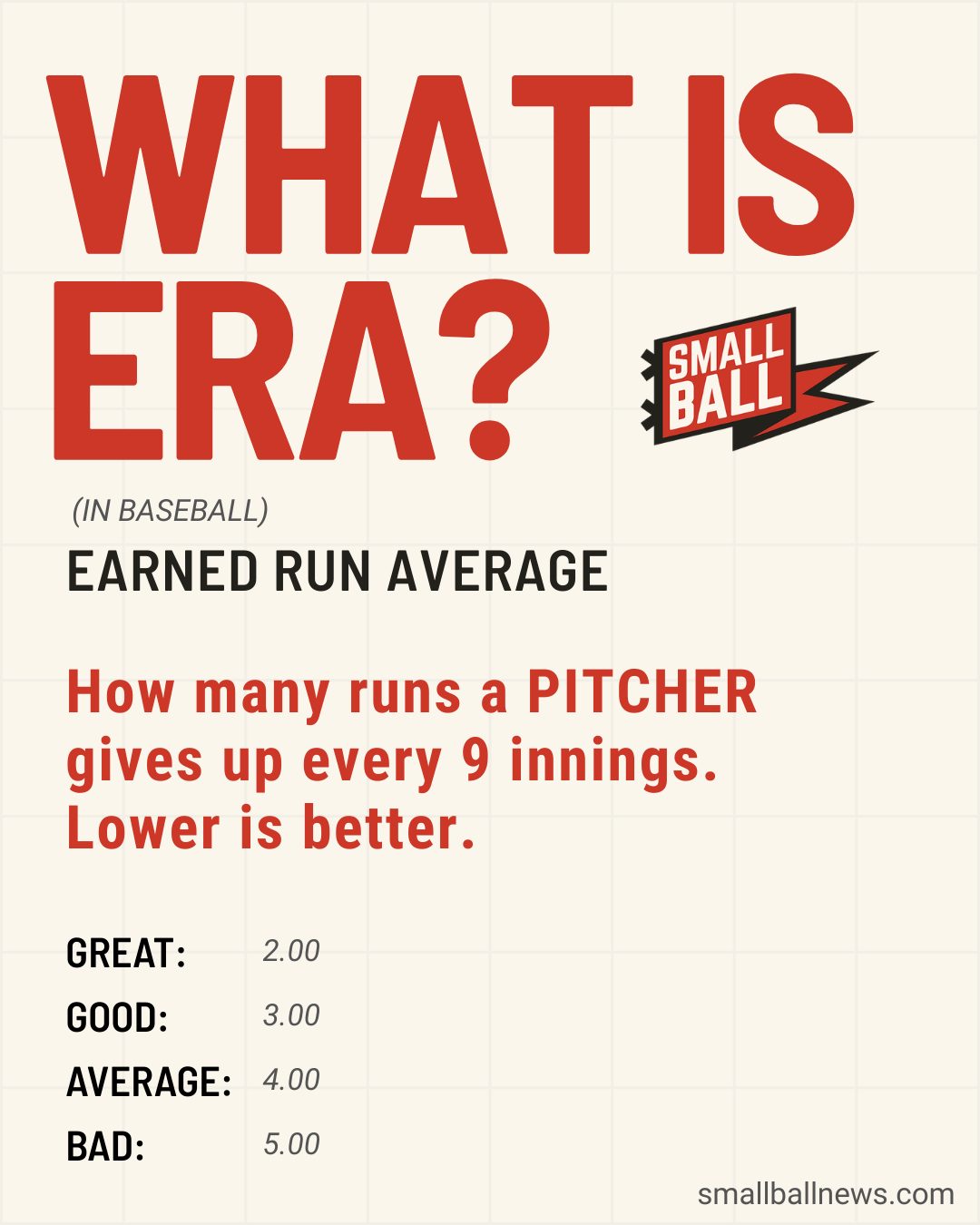
Earned Run Average (ERA) measures how many earned runs a pitcher allows per nine innings. It takes the runs a pitcher is directly responsible for, strips out the ones caused by defensive mistakes behind him, and normalizes everything to a standard game length. Lower is better.
A 2.50 ERA means a pitcher allowed, on average, two and a half earned runs for every nine innings he worked. A 4.50 means four and a half. The gap between those two numbers is the gap between an ace and a back-of-the-rotation arm filling a spot.
ERA has been the standard measure of pitching quality since the early 1900s. It predates WAR, FIP, xERA, and every advanced metric by decades.
Your grandfather knew what a good ERA looked like. Running 30 team digests at Small Ball recalibrated my sense of what the numbers actually mean, though. I’d assumed under 2.00 was good and above 3.00 was a problem. The actual scale is much wider than that.
The Math
ERA = (Earned Runs / Innings Pitched) x 9
Skenes allowed 41 earned runs across 187.2 innings in 2025 (the “.2” means two outs into the inning, so 187 and two-thirds):
(41 / 187.67) x 9 = 1.97
The “times 9” normalizes everything to a nine-inning game so you can compare a guy who threw 6 innings to a guy who threw 8. A pitcher who gives up 3 earned runs over 6 innings has a 4.50 ERA for that outing. Three runs in six frames might not sound terrible, but 4.50 per start adds up fast over a full season.
One detail that matters: earned runs are only the runs where every baserunner reached without the help of an error or passed ball. If a runner reaches on a throwing error and later scores, that run is “unearned” and doesn’t touch the pitcher’s ERA. The official scorer makes this call, which introduces human judgment into what looks like a clean number.
The ERA Scale
Most fans have the scale wrong. Under 2.00 feels like the bar for “good” because the numbers look small. But league average ERA in 2025 was 4.15. Under 2.00 isn’t just good; it’s historically dominant.
Only one qualified starter got there last year.
| ERA | What It Means | 2025 Example |
|---|---|---|
| Under 2.00 | Historically dominant | Paul Skenes (1.97) |
| 2.00-2.50 | Elite, Cy Young caliber | Tarik Skubal (2.21), Hunter Brown (2.43) |
| 2.50-3.20 | Great, All-Star level | Cristopher Sanchez (2.50), Max Fried (2.86) |
| 3.20-3.80 | Above average, solid starter | Mid-rotation arms |
| 3.80-4.40 | League average | Where most starters live |
| 4.40-5.00 | Below average | Back-end starters, spot starts |
| Above 5.00 | Bad | Emergency arms, roster filler |
Zack Wheeler was sitting at a 2.71 ERA with a 0.94 WHIP when thoracic outlet syndrome ended his season in August. He didn’t qualify for the ERA title (you need roughly 162 innings, and he threw 149.2), but in the starts he made, he was every bit as dominant as the names above him on that leaderboard.
Tarik Skubal won his second consecutive AL Cy Young with a 2.21 ERA, 241 strikeouts, and a 0.89 WHIP. First pitcher to go back-to-back since Pedro Martinez in 1999-2000. A 3.20 ERA might not make highlight reels, but in a league where average is above 4.00, that pitcher is giving his team a genuine chance to win every time out. The scale is wider than it looks.
Get daily baseball updates, free
Scores, recaps, standings and Vibe Checks every morning.
Where ERA Falls Apart
ERA looks authoritative. Two decimal places. Precise and final. I think it’s the most trusted pitching stat in baseball and also the most misleading, because it hides as much as it reveals.
Defense is invisible. Two pitchers can throw identical stuff and post different ERAs because one has Gold Glovers behind him and the other has a shortstop who boots routine grounders. ERA assigns credit and blame entirely to the pitcher, regardless of who’s fielding behind him.
Ballparks are ignored. Pitching half your games at Coors Field in Denver will inflate your ERA compared to pitching at Oracle Park in San Francisco. ERA treats both environments the same. That’s why ERA+ exists (it adjusts for park and league, centering 100 as average), but raw ERA remains the version most fans see.
The earned/unearned line is a judgment call. An official scorer decides which runs count against a pitcher based on whether an error “should have” ended the inning. Different scorers make different calls. Some runs that feel like they belong on the pitcher get wiped by a generous error ruling.
Inherited runners create wild distortions. If a starter leaves with two men on and the reliever lets them score, those runs hit the starter’s ERA. The reliever who inherited a bases-loaded mess and surrendered a grand slam gets zero earned runs. This makes reliever ERA especially unreliable.
Then there’s the gap between ERA and what a pitcher actually controlled. Trevor Rogers posted a sparkling 1.81 ERA in 18 starts for the Orioles in 2025. His FIP (Fielding Independent Pitching, which only counts strikeouts, walks, and home runs) came in at 2.82, a full run higher. His batting average on balls in play was an unsustainably low .212.
Analysis put his “true talent” ERA closer to 4.31. Rogers looked like a Cy Young candidate by ERA. The underlying numbers said he was riding an extreme wave of batted-ball luck.
Compare that to Skubal, whose 2.21 ERA and 2.45 FIP were separated by just 0.24 runs. That tight alignment means his results were backed by elite strikeout stuff and pinpoint control, not propped up by defense or fortune. When ERA and FIP converge, you can trust the number. When they diverge by a full run, somebody’s getting lucky.
A 3.50 in April and a 3.50 in September
ERA is cumulative. It smooths everything into one number across months of starts. A pitcher sitting at 3.50 in September could be a guy who opened the year at 5.00 and has been unhittable since June. Or he could be a guy who cruised at 2.50 through July and has gotten shelled in his last six outings.
Same number. Completely different trajectories.
One of those pitchers has momentum building; the other is losing it. If your team is fighting for a playoff spot, the difference between those two arcs matters enormously. ERA can’t tell you which pitcher you’re looking at. It only captures the cumulative total, flattened across time.
That’s the blind spot Small Ball's Vibe Check was designed for. It tracks pitcher and team momentum as it shifts, not just where the numbers settle when the season ends.
A 3.50 ERA pitcher in the middle of a seven-start run where he’s allowed two runs or fewer in six of them is a completely different animal than a 3.50 ERA pitcher who just gave up 14 runs across his last three starts. ERA sees the same guy. Our Vibe Check sees the difference.
Your Pitcher’s Full Story, Every Morning
Small Ball’s daily digest tracks your team’s pitching staff with the traditional numbers and Vibe Check, delivered free before first pitch. ERA tells you the season. Vibe Check tells you the moment. Pick your team and subscribe.
 Arizona Diamondbacks
 Atlanta Braves
 Baltimore Orioles
 Boston Red Sox
 Chicago Cubs
 Chicago White Sox
 Cincinnati Reds
 Cleveland Guardians
 Colorado Rockies
 Detroit Tigers
 Houston Astros
 Kansas City Royals
 Los Angeles Angels
 Los Angeles Dodgers
 Miami Marlins
 Milwaukee Brewers
 Minnesota Twins
 New York Mets
 New York Yankees
 Oakland Athletics
 Philadelphia Phillies
 Pittsburgh Pirates
 San Diego Padres
 San Francisco Giants
 Seattle Mariners
 St. Louis Cardinals
 Tampa Bay Rays
 Texas Rangers
 Toronto Blue Jays
 Washington Nationals